
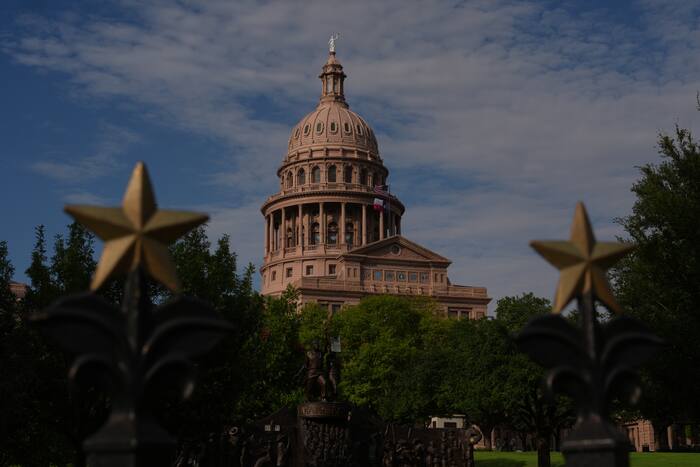
Soaring water bills, massive data centers and how Texas handles students who repeatedly miss school could all become the subjects of new legislation as state lawmakers prepare to return to Austin.
Monday, Nov. 9, marks the first day lawmakers can begin filing bills for the 2027 legislative session, offering Texans an early glimpse of the proposals that could eventually become state law.
And several Greater Houston lawmakers have already identified changes they want to pursue.
The filing period also comes less than a week after Democrats flipped the Texas House and won the governor’s office, while Republicans retained control of the Senate.
That means some proposals that struggled in previous sessions could get another chance, although lawmakers will still need to navigate a divided Legislature.
Here’s what Houston-area representatives and senators have said they want to tackle.
State Rep. Cody Vasut, a Republican from Angleton, has committed to reviving legislation that would give counties greater authority over large developments, including data centers.
The proposal would address concerns involving noise, public health and safety in unincorporated areas, where counties have fewer land-use regulatory powers than cities.
Vasut introduced similar legislation during the previous session, but it never reached the House floor.
“When you develop in the county, it’s been viewed kind of as the Wild West,” Vasut said during a public meeting in Brazoria County.
He has argued that counties need additional tools as industrial projects increasingly move closer to residential neighborhoods.
Not all Republicans agree. Houston-area Sen. Paul Bettencourt has argued that data center regulations should be established statewide rather than allowing individual communities to adopt different rules.
Meanwhile, Houston Democratic Rep. Senfronia Thompson has raised another concern: Who should pay for the infrastructure needed to support the growing industry?
During an August legislative hearing, Thompson questioned why residents should bear costs associated with data centers they had little say in approving.
“Data centers are being pushed upon them, and they don’t have a choice to say no. But they’ve got to pay. I think that’s unfair. It’s undemocratic,” Thompson said.
The issue could also overlap with Governor-elect Gina Hinojosa’s agenda. She has called for new restrictions on data center development and changes to industry tax incentives.
RELATED COVERAGE:
State Rep. Tom Oliverson, a Republican representing northwest Harris County, wants changes to how private water utilities charge customers following complaints about soaring Aqua Texas bills.
As KPRC 2 previously reported, some customers have received monthly bills exceeding $1,000, prompting lawmakers to question how the increases were allowed.
“I am urging the Public Utility Commission to reject the proposed rate filing and furthermore to direct Aqua Texas to refund all of the excessive charges,” Oliverson told KPRC 2.
The controversy could also lead to changes in how private utilities impose temporary rate increases, recover infrastructure costs and bill customers for wastewater services.
Oliverson is not alone.
Republican state Reps. Gary Gates and Cody Harris have also examined whether state regulations allow private utilities to impose substantial rate increases before regulators complete their reviews.
Gates has questioned whether lawmakers need to close gaps in existing rules.
Aqua Texas maintains that its rates reflect infrastructure investments intended to improve service and reliability. Its rate case remains under review.
The lawmakers have not announced specific 2027 bill numbers, but their comments suggest utility regulation could receive renewed attention when the Legislature convenes.
RELATED COVERAGE: KPRC 2’s Aqua Texas investigation
Houston Republican Sen. Paul Bettencourt has identified chronic truancy as a priority for the 2027 legislative session.
Bettencourt previously pursued legislation to restore a civil truancy process for students who repeatedly miss school, but those efforts failed to pass.
He told KPRC 2 Investigates last November that he intends to work with the Texas Education Agency (TEA) to refine the proposal for another attempt.
“I’m going to be talking to TEA and say, ‘this is the focus.’ We tried to pass this bill twice. I want this bill tuned up to be the best it can be for the third pass,” Bettencourt said.
The proposal could reignite a debate over how Texas should address students who are chronically absent.
But Houston Democratic Rep. Gene Wu has questioned whether tougher truancy enforcement would address the circumstances keeping students out of classrooms.
“Think about kids who are living in abject poverty, living in violent environments, living in difficult family situations. What are you going to do to them? Are you just going to punish them more than what life has already thrown at them?” Wu told KPRC 2 Investigates last November.
Wu has instead advocated for additional resources to address barriers to school attendance, including transportation difficulties and family instability.
RELATED COVERAGE: KPRC 2 Investigates school attendance
Houston Democratic Rep. Christina Morales has identified repealing Texas’ private school voucher program and expanding Medicaid as priorities for the incoming House majority.
Morales, who leads the House Democrats’ campaign arm, also wants lawmakers to revisit legislation she says unfairly targets immigrants and communities of color.
The voucher program, approved in 2025, allows eligible families to use state funds toward private education expenses.
Its repeal would mark a major change in Texas education policy, although any legislation would still need approval from the Republican-controlled Senate.
Medicaid expansion could face similar obstacles after years of Republican opposition.
Both issues align with priorities outlined by Hinojosa, who has called for strengthening public schools and expanding health coverage.
Morales has not publicly confirmed specific bills she intends to file Monday, but her comments offer an early indication of the policies the new House majority may pursue.
The 90th Texas Legislature will officially convene Jan. 12, 2027, but lawmakers can begin submitting bills Monday.
Some Houston-area lawmakers have explicitly committed to reviving legislation, while others have identified policy changes they want considered. Those proposals are not necessarily bills that will be filed on the first day.
The filing period could be busy.
According to the Texas Municipal League, lawmakers filed a record 1,471 bills on the first day of prefiling in November 2024.
Thousands more followed during the 2025 session, but only a fraction ultimately became law.
This time, the political balance in Austin will be different.
Democrats will control the House and governor’s office, while Republicans will maintain their Senate majority. Major legislation will generally need support from both chambers to advance.
For Greater Houston residents, the coming weeks will offer a clearer picture of which promises local lawmakers intend to put into writing.
Texans can track newly filed legislation, search by lawmaker and follow individual bills through Texas Legislature Online.


